
Measures that relieve tennis elbow
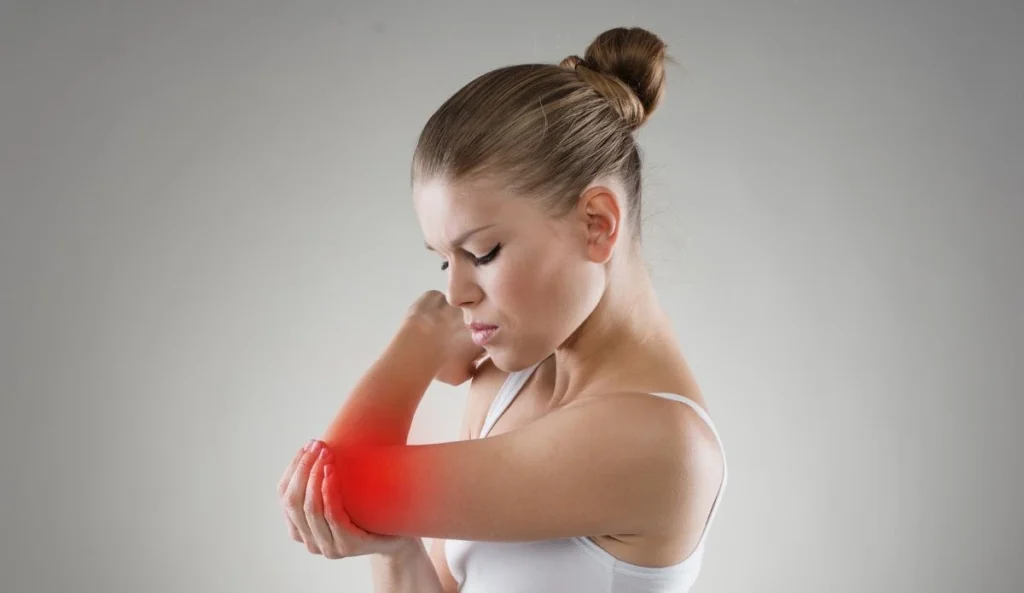
“Tennis elbow” is the name given to lateral epicondylalgia, pain on the outside of the elbow, almost always linked to tendon overload. which extend the wrist and fingers (very close to the bone, in the lateral epicondyle). It does not only occur in tennis players, it can also happen, for example, in:
What measures to take
- Adjust the movement;
- Targeted strengthening;
- Temporary use of assistive products.
Elbow pad - temporary aid
Benefits
- Creates localized compression, which reduces direct tension on the tendon during movement;
- Reduces pain in everyday tasks without forcing you to stop everything;
Helps maintain function during more sensitive phases, especially when unavoidable activities are involved (manual labor, mouse/keyboard use, light lifting).
When to use
- During activities that cause pain, especially in the initial phase or during periods of increased irritation;
For repetitive tasks where you need to keep working but want to reduce discomfort.
When to avoid
- At rest, because it adds nothing and only creates dependency;
- During strengthening exercises, because the goal is to give the tendon the right amount of load to recover, not to “protect” it from everything;
- If you start needing it for everything, it’s a sign that active recovery (adjustments + load progression) is not well oriented.
How to use
- Position it so that it is comfortable and secure, without numbing your hand or squeezing too tightly;
Use it only as long as necessary for activities that trigger pain.
Other measures that help with relief
Applying ice can be helpful after more demanding activities, especially when there is increased sensitivity, thus reducing discomfort.
Sleeping well and giving your muscles the rest they need helps with recovery and improves any discomfort.
Massage
Massage can help relieve discomfort by lowering the tone (basic muscle tension) of the forearm, easing that tight string sensation and reducing sensitivity before using the hand again.
Works best when:
- The pain is more of an “irritation” and stiffness than a sharp twinge;
- Your forearm feels heavy, loaded, always tense;
- You have pain in your grip and notice that you squeeze everything tightly.
How to do it (simple self-massage)
- 2–5 minutes, 1 to 2 times a day.
- Focus on the muscle on the outside of your forearm (extensors), just below the elbow. Not on top of the bone.
- Moderate and slow pressure. If you have to shrug your shoulders or hold your breath, you’ve gone too far.
- You can use your fingers, a small ball, or a soft roller.
When to avoid
- If the area is “hot,” very sensitive to touch, or if the pain increases in the following hours.
- If you use massage to avoid adjusting and continue with the same load and the same routine.
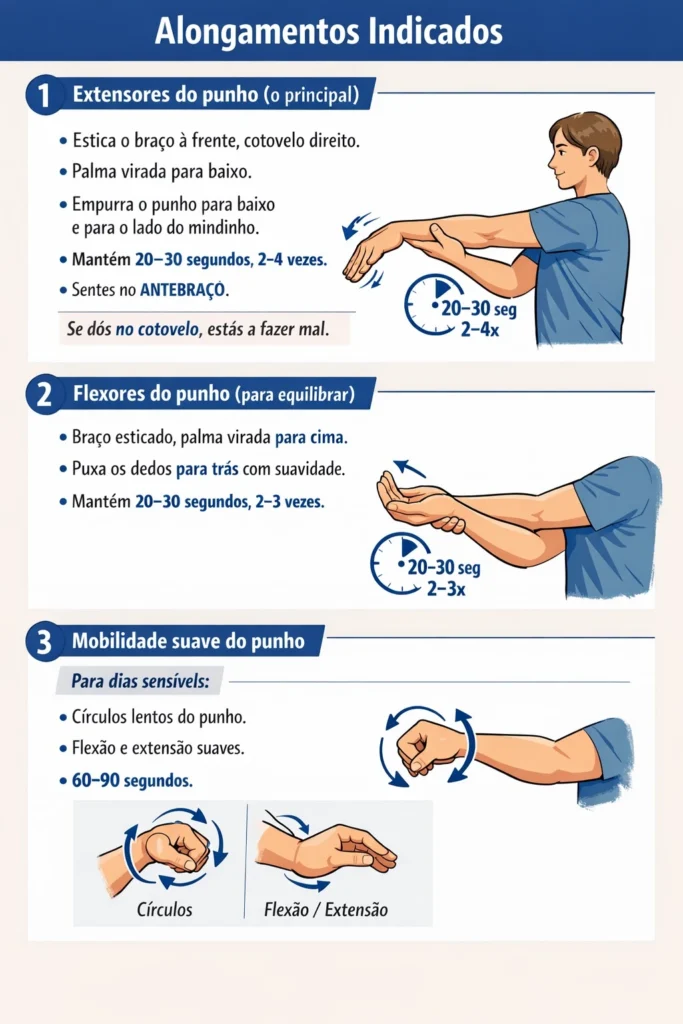
Stretching: when it helps and when it hinders
An irritated tendon requires extra care, so if any stretching is done, it should be gentle.
When stretching
- when the pain is under control and the goal is to relieve stiffness;
- after warming up (or after a hot shower, or at the end of a workout);
- on days when sensitivity is lower.
When it doesn't make sense
- At the peak of pain or when any tension triggers symptoms;
- “To see if it passes,” coldly, with your arm completely tense;
- Before a task that already causes you pain, it makes you more sensitive.
Before or after?
- Before it hurts: Do not use intense stretching as prevention. If you want to do something before a demanding task, choose Light warm-up and activation (controlled wrist movements, gentle squeezes, short isometrics).
- After pain (or after activity): gentle stretching can help, as long as the pain is already “low volume.”
Your safety is our priority.
Related Frequently Asked Questions:
Could this become something “chronic” forever?
It doesn’t have to be that way. What usually makes pain persistent is keeping the tendon in the same cycle: either you demand too much of it, or you protect it too much and it loses tolerance. When there is a clear strategy, with well-measured load and sufficient time for adaptation, most people recover function and greatly reduce pain, even in long-standing cases.
Can I continue training at the gym?
You can, as long as you choose exercises and variations that don’t cause the pain to flare up. The typical mistake is to insist on the same grip, the same range of motion, and the same load, just “enduring” it. In many cases, switching from bars to dumbbells, using more neutral grips, reducing the grip requirement, and controlling the pace already allows you to train without aggravating the problem.
The pain is very noticeable when grabbing things. Is this normal?
It is one of the most common patterns because gripping involves the forearm muscles constantly and automatically. Pain tends to appear in everyday movements, such as carrying bags, opening lids, using tools, or even holding a cell phone, because gripping puts continuous strain on the tendon. The solution is rarely to “not pick anything up,” but rather to choose more carefully when to exert yourself and when to take it easy.
Should I take anti-inflammatory drugs to get better faster?
They may provide short-term relief, but they are not a substitute for the main treatment, which is to restore the tendon’s tolerance to stress. If the relief causes you to do more than you are capable of at that moment, it could be costly. If you are considering using medication, it is advisable to consult a healthcare professional, especially if you have other conditions or are already taking other medications.
Is there a sleeping position that helps?
The most important thing is to avoid spending hours with your elbow bent and your wrist “closed” under your body, as this can increase stiffness when you wake up. Many people improve just by supporting their arm better, keeping their wrist more neutral, and not falling asleep with their hand trapped between the mattress and their torso. Small adjustments, big difference.
Does working on a computer really make things worse? What can be changed without complicating matters?
It gets worse when you work for many hours straight without breaks and with your wrist out of position, especially if you are constantly clicking the mouse. Adjusting the height of your desk, moving the keyboard closer, supporting your forearm, and taking micro-breaks of 30–60 seconds throughout the day usually reduces the accumulated strain without forcing you to “stop working.”
What indicates that I should be evaluated by a professional?
If the pain does not improve despite consistent adjustments over a few weeks, if you have marked loss of strength, numbness/tingling, pain that radiates to the hand, or if there is nighttime pain that does not go away, it is worth getting it checked out. In these cases, other structures may be involved, or the load may be poorly balanced without you realizing it.

Europe Marathon 2026: information and post-race details
The 2026 European Marathon will take place in Aveiro on the weekend of April 25 and 26. On Saturday, April 25, the Mini-Marathon (10 km) will start at 8:00 a.m. On Sunday, April 26, the Marathon, Half Marathon, and Walk will start at 8:00 a.m.

Knee pain and adjustments in cycling
Many people with knee pain tolerate cycling better than running, as it is supposedly a lower-impact activity. With the load well distributed and practiced correctly, this sport can help strengthen the thigh and improve the knee’s tolerance to exertion. But then, why is it that in some cases this discomfort is still related to this practice? These and other questions will be answered in this article.
Sore shins?
It may seem like a minor issue until it starts to limit your ability to perform more strenuous activities. Have you ever experienced pain in your shins? Perhaps this discomfort occurred on the front or inner side of your tibia. This complaint is often associated with people who run, jump, or rapidly increase their training load. The diagnosis may be medial tibial stress syndrome, better known as shin splints.
